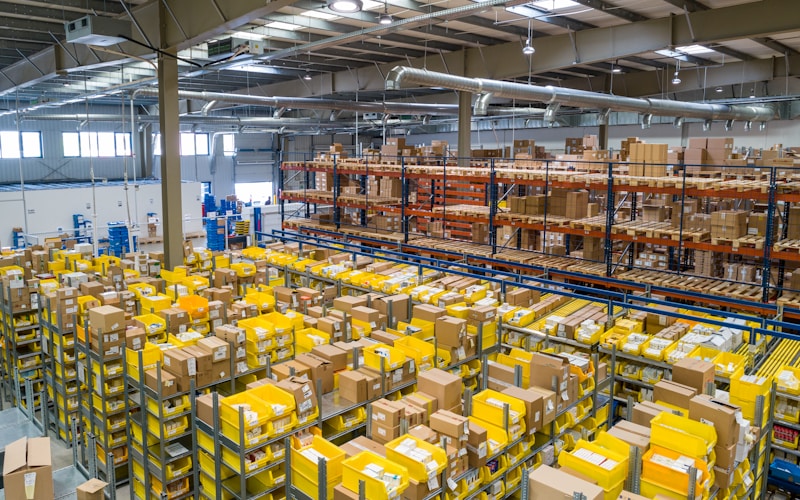
A 4PL, or fourth-party logistics provider, is a partner that designs, integrates, and manages your entire supply chain, including the 3PL warehouses, carriers, and software that execute it, under one contract and one point of accountability. If you are asking what is 4PL in plain terms: a 3PL runs logistics assets, while a 4PL runs your logistics network.
That one-sentence answer hides a real strategic decision. If you lead an international brand entering or scaling in the U.S., the question is not academic. It decides whether your team manages five vendors across time zones, or one partner who manages the five vendors for you. This guide covers the full picture: the formal definition, where the model came from, how it works day to day, how it compares to 3PL, what it costs, and how to decide whether your brand actually needs one.
What Is 4PL? Fourth-Party Logistics Defined
A fourth-party logistics provider is an integrator that takes responsibility for a company's end-to-end supply chain, including managing the third-party providers who physically execute the work. Where a 3PL runs a warehouse or a trucking lane, a 4PL runs the system: it selects warehouses, negotiates freight, integrates software, plans inventory, and reports on the whole operation as one unit.
The cleanest way to understand the 4PL meaning is by what the provider owns. A traditional 3PL owns assets: buildings, racking, forklifts, sometimes trucks. It sells you capacity in those assets. A 4PL typically owns little or none of that. Instead, it owns the orchestration layer:
- Network design: deciding which warehouses, in which regions, should hold which products
- Vendor management: selecting, contracting, and holding accountable the 3PLs, carriers, and customs brokers who execute
- Systems integration: connecting ERP, WMS, TMS, and marketplace APIs into a single operating picture
- Planning and analytics: demand forecasting, inventory optimization, and performance management across the network
- Single-point accountability: one contract, one dashboard, one team responsible for the end-to-end result
Because a 4PL is not selling its own warehouse space, its incentives point in a different direction. It is not trying to fill a building it owns; it is trying to design the lowest-cost, highest-performance network from whatever capacity the market offers. That neutrality is the core of the model, and it is why Gartner defines a 4PL as a provider that manages the design, build, run, and orchestration of all or part of an end-to-end logistics network, with ownership of outcomes rather than just visibility.
A useful mental model: a 3PL is a contractor you hire to build one room. A 4PL is the general contractor and architect who designs the house, hires every specialist trade, supervises the build, and hands you the keys.
Where Did the 4PL Model Come From?
The 4PL concept is the fourth step in a progression that tracks how much of the supply chain a company hands to outside partners. The sequence matters because most brands climb it in order:
- 1PL (first-party logistics): a manufacturer or retailer moves its own goods with its own trucks and warehouses. Everything stays in-house.
- 2PL (second-party logistics): the company hires asset-based carriers, such as trucking firms and ocean lines, but still manages warehousing and coordination itself.
- 3PL (third-party logistics): the company outsources warehousing and fulfillment operations to specialists, but keeps strategic control and vendor coordination in-house.
- 4PL (fourth-party logistics): the company outsources the coordination itself. A lead partner manages the 3PLs, carriers, and systems, and answers for total supply chain performance.
The term fourth-party logistics was coined in the consulting world of the mid-1990s, when large enterprises started hiring a lead logistics partner to manage increasingly tangled global networks. For roughly two decades, 4PL arrangements were mostly the territory of Fortune 500 manufacturers with nine-figure logistics budgets.
Two forces democratized the model. First, e-commerce turned every consumer brand into a multi-channel, multi-warehouse operation. U.S. retail e-commerce sales reached 1.23 trillion dollars in 2025, or 16.4% of total retail sales, according to the U.S. Census Bureau, and every one of those orders had to route through some combination of marketplaces, warehouses, and parcel carriers. Second, cloud systems and APIs made it possible to integrate a network of independent warehouses and carriers without owning any of them. By the mid-2020s, a mid-sized international brand could buy orchestration capability that once required an enterprise IT department.
The clearest sign the model has matured: Gartner published its first Magic Quadrant for Fourth-Party Logistics in 2025, formally defining a market segment that had been discussed for thirty years but never independently benchmarked.
How Does a 4PL Actually Work Day to Day?
A 4PL works by placing a dedicated orchestration team between your brand and every executing vendor. That team owns four layers: strategy and network design, vendor execution management, systems and data, and ongoing planning. You interact with one partner; the partner interacts with everyone else and reports results back as a single operating picture.
Definitions are abstract, so walk through what that means in a normal week.
The orchestration layer
At the center sits a team of supply chain strategists, marketplace operators, and planners who function as your outsourced supply chain department. They set network strategy, run weekly and monthly planning cycles with your team, and manage every downstream provider. When a warehouse misses its SLA, a container gets rolled at origin, or a marketplace changes its routing rules, the 4PL absorbs the problem and resolves it. You see the decision and the result, not the forty emails in between.
The execution layer
Under the orchestration team sits the physical network: 3PL warehouses, freight forwarders, parcel and LTL carriers, customs brokers, and returns processors. The 4PL selects these vendors, negotiates rates using pooled volume across its client base, sets performance standards, and replaces underperformers. A strong vendor management practice is the difference between a 4PL that adds a layer of value and one that just adds a layer of markup.
The technology layer
The 4PL connects your sales channels, its own planning systems, and every vendor's WMS and TMS into one data spine. This is where many logistics relationships break down: in the 30th annual Third-Party Logistics Study from Penn State, NTT DATA, and Penske Logistics, 93% of shippers said IT capability is a necessary element of provider expertise, but only 54% were satisfied with their providers' IT capabilities. Closing that gap is a core part of the 4PL job, typically through a commerce data platform that unifies orders, inventory, and shipment data across every channel and warehouse.
The planning layer
Finally, the 4PL runs the forward-looking work: demand forecasting by channel, inventory positioning across nodes, replenishment triggers, and promotion planning. A typical purchase order cycle looks like this:
- The 4PL forecasts demand by SKU and channel, and drafts the PO quantity.
- Your team approves the buy; the 4PL books origin freight and files customs documentation.
- Inbound stock is allocated across the warehouse network based on regional demand.
- Orders flow automatically from each channel to the right node; exceptions route to the 4PL team.
- Weekly reporting closes the loop: fill rate, on-time delivery, landed cost, and inventory health.
What Is 4PL vs 3PL? Execution vs Orchestration
The difference between 3PL and 4PL is scope of responsibility. A 3PL executes defined functions, such as storage and fulfillment, from assets it operates, while you coordinate everything around it. A 4PL takes responsibility for the whole chain, manages the 3PLs and carriers inside it, and gives you a single accountable partner instead of a vendor list.
| Dimension | 3PL | 4PL |
|---|---|---|
| Core product | Capacity: space, labor, transport | Outcomes: an orchestrated network |
| Assets | Owns warehouses and equipment | Typically asset-light; owns the management layer |
| Scope | One function or facility | End-to-end supply chain |
| Vendor coordination | You manage other vendors | The 4PL manages all vendors, including 3PLs |
| Accountability | SLA on its own tasks | Single point of accountability for total performance |
| Technology | Its own WMS or TMS | Integration spine across every system and channel |
| Best fit | Domestic brands scaling one channel | Multi-channel and international operations |
Two clarifications keep this honest. First, 4PL does not replace 3PL; it manages it. Every 4PL network contains 3PLs doing excellent physical work. Second, plenty of brands do not need a 4PL yet. If you sell one channel from one region, a good 3PL plus a spreadsheet is a perfectly rational setup. The full breakdown of all four models is in our guide to 4PL vs 3PL vs 2PL vs 1PL.
How Big Is the 4PL Market in 2026?
The 4PL market is substantial and growing faster than logistics overall. According to Global Market Insights, the global fourth-party logistics market reached 86.2 billion dollars in 2025 and is projected to grow at about 6.7% annually through 2035. Adoption data suggests the model is moving from early to mainstream among supply chain leaders.
The most striking evidence comes from Gartner. In its 2026 Logistics and External Manufacturing Outsourcing Trends Survey of nearly 220 supply chain leaders, 42% said they already outsource to a 4PL, and a further 35% said they plan to within the next two years. If those intentions hold, roughly three in four large-company supply chains will run on some form of orchestration outsourcing by 2028.
The broader context supports that trajectory:
- Armstrong & Associates' 2026 research finds 94% of domestic Fortune 500 companies work with at least one 3PL, up from 46% in 2001, in a global 3PL market it estimates at about 1.3 trillion dollars for 2025.
- Precedence Research puts the global logistics outsourcing market at 1.38 trillion dollars in 2025, projected to reach 2.19 trillion dollars by 2035.
- In the 2026 Third-Party Logistics Study, 81% of shippers reported increasing their use of outsourced logistics.
Read those numbers together and the pattern is clear: outsourcing execution is already near-universal among large companies, and outsourcing coordination is the next step. The 4PL market is where the 3PL market was two decades ago.
Who Needs a 4PL?
A 4PL fits companies whose core problem is coordination, not capacity. The strongest fit is an international or multi-channel brand that must run a U.S.-grade supply chain without a U.S. team: it needs warehouses, freight, marketplaces, compliance, and planning to work as one system, managed by one accountable partner.
For an international brand entering the U.S., the case is concrete. Landing in the American market typically requires an importer of record, a customs broker, a freight forwarder, one or more regional warehouses, parcel carrier accounts, marketplace integrations, and someone to plan inventory across all of it. Hiring that expertise locally takes quarters you may not have. Signal checks that you are a 4PL candidate:
- You sell, or plan to sell, on three or more U.S. channels, such as Amazon, Walmart, Target Plus, and your own site
- Your headquarters sits outside the U.S. and cannot manage American vendors across time zones
- You are coordinating four or more logistics vendors and the coordination itself consumes senior staff time
- Inventory is fragmented across channels, so one channel runs out while another sits overstocked
- You need U.S. retail compliance, such as routing guides and EDI, that your home team has never operated
If most of that list sounds familiar, orchestration is your bottleneck. If little of it does, a straightforward logistics and fulfillment setup with a single 3PL will serve you better for now.
What Are the Limitations of a 4PL?
No serious guide should skip the trade-offs, and the 4PL model has real ones.
- Distance from execution. You manage outcomes, not operations. If you love walking your own warehouse floor, the model will feel remote by design.
- Concentration risk. One partner touches everything. A weak 4PL propagates weakness across your whole chain, so diligence on references, systems, and vendor contracts matters far more than with a single-function vendor.
- Switching cost. The 4PL holds your vendor relationships and system integrations. Exit is possible, and a good contract plans for it, but it is a project, not a phone call.
- A management layer you must be able to justify. At low volume or single-channel scale, the orchestration fee can exceed the value of the coordination it replaces.
The IT gap cuts both ways here too. The same Third-Party Logistics Study finding, that 93% of shippers call technology essential while only 54% are satisfied with their providers' technology, applies to 4PLs as much as 3PLs. A 4PL whose integration layer is really a team of coordinators forwarding emails is charging orchestration prices for clerical work. Ask to see the data platform live before you sign.
How Much Does a 4PL Cost?
A 4PL is typically priced as a management layer on top of executed logistics costs, using one of four structures: a fixed monthly management fee, cost-plus on managed spend, a gain-share tied to documented savings, or a blended per-order rate that folds orchestration into fulfillment pricing. Total spend depends on channels, order volume, and network complexity.
What actually drives your price:
- Scope: freight plus warehousing plus marketplaces costs more to manage than fulfillment alone
- Channel count: each marketplace adds integration and compliance work
- Network nodes: more warehouses mean more inventory planning and more vendor management
- Service level: weekly planning cadence and dedicated staffing cost more than monthly reporting
The economics usually hinge on three offsets. A 4PL buys freight and warehousing with pooled volume across clients, which a mid-sized brand cannot match alone. It removes duplicated overhead, since you are not hiring a U.S. supply chain manager, an integrations developer, and a compliance analyst. And it reduces expensive failure modes, such as chargebacks, stockouts, and expedited freight, that come from coordination gaps. Shipper-reported data backs the direction: in the 2025 Third-Party Logistics Study, 75% of shippers said outsourced logistics providers helped reduce their overall logistics costs, up from 66% the year before. Whether the offsets beat the fee at your volume is a spreadsheet exercise, and a credible 4PL will build that model with you before asking for a signature.
Which Logistics Model Fits Your Growth Stage?
Match the model to your operating complexity, not your ambition.
- Starting out, one market, low volume: stay in-house or use a single carrier relationship. Speed of learning beats efficiency at this stage.
- Scaling domestically, one or two channels: bring in a 3PL for warehousing and fulfillment. Keep planning and vendor choices in-house.
- Multi-channel, multi-warehouse, still one country: add integration tooling or a managed-services layer. You are approaching the coordination ceiling.
- International expansion into the U.S., three or more channels: this is 4PL territory. The problem is no longer any single function; it is making the functions work as one system across an ocean.
A simple test: list every logistics decision your senior team touched last month. If most were about doing the work, hire executors. If most were about coordinating the people doing the work, hire an orchestrator.
How Pi-Commerce Helps International Brands Run the 4PL Model
Pi-Commerce is a U.S.-based 4PL built for exactly one scenario: an international brand that needs an American supply chain without building an American operations team. We design your network, run integrated supply chain management across warehousing, freight, and marketplaces, manage every executing vendor, and unify orders, inventory, and shipment data on one platform, so your team sees a single weekly picture instead of a vendor inbox.
One example of how that plays out: a European beauty brand came to us selling through a single U.S. 3PL, with Amazon growing, Target Plus pending, and stockouts on its top five SKUs every month. We repositioned inventory across two nodes, took over freight and replenishment planning, and onboarded the retail channels against their compliance requirements. The brand's team went from managing six vendors to attending one weekly call.
If you are weighing what a 4PL would look like for your U.S. expansion, talk to our team. We will map your current vendor stack against an orchestrated model and show you the cost and service math before you commit to anything.